AI Visibility by Industry: What the Data Says About Your Vertical
AI visibility varies dramatically by industry. IT gets 11x more AI traffic than communication services. Healthcare triggers AI Overviews 88% of the time. Here is what the research says about your vertical.

Most AI visibility advice treats every business the same. "Add schema markup. Write FAQ pages. Get more brand mentions." That advice is not wrong, but it misses the point. The data shows that AI visibility works very differently depending on your industry, and the strategy that works for a SaaS company can be the wrong priority for a retailer.
We pulled data from three major studies to build an industry-by-industry breakdown: the Conductor 2026 AEO/GEO Benchmarks Report (13,770 domains, 21.9 million Google searches, 17 million AI responses, 100 million+ citations), BrightEdge's one-year AI Overviews analysis across nine industries, and Adobe Analytics' holiday 2025 AI shopping data. Every number in this article comes from one of those sources.
The Big Picture: AI Traffic Is Not Evenly Distributed
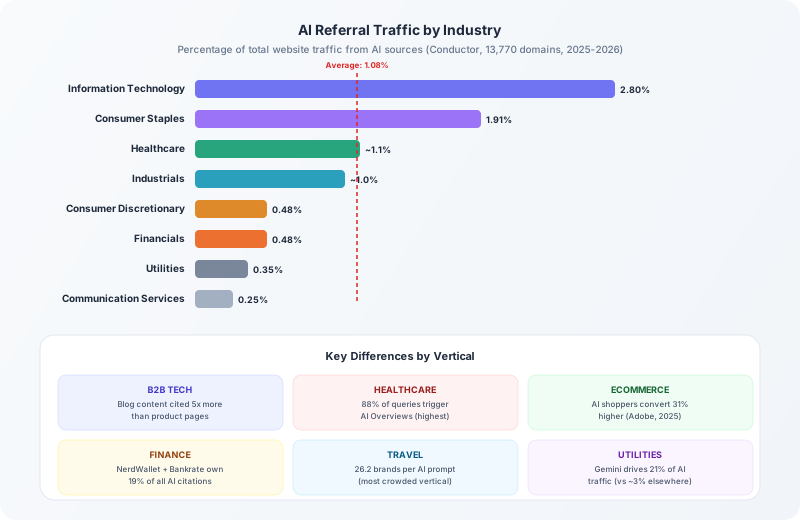
The average share of total website traffic coming from AI referrals is 1.08% across all industries (Conductor, 2026). But that average hides enormous variation. Information Technology receives 2.80% of its traffic from AI sources. Communication Services receives just 0.25%. That is an 11x difference.
Here is how AI referral traffic breaks down by industry, according to Conductor's analysis of 13,770 domains from May through September 2025:
- Information Technology: 2.80% (highest of any industry)
- Consumer Staples: 1.91%
- Healthcare: approximately 1.1%
- Industrials: approximately 1.0%
- Consumer Discretionary (retail, ecommerce): 0.48%
- Financials: 0.48%
- Utilities: 0.35%
- Communication Services: 0.25% (lowest of any industry)
These numbers tell you something important: if you are in IT or consumer staples, AI is already a meaningful traffic channel. If you are in finance or retail, AI traffic is smaller but growing, and the strategic value may be more about brand perception than direct traffic.
Which AI Engines Matter for Your Industry
ChatGPT dominates AI referral traffic across every industry, but its share varies. And the secondary engines differ significantly by vertical. This matters because optimizing for ChatGPT alone means missing traffic that other industries are capturing from Perplexity, Gemini, or Copilot.
Conductor's data shows the engine breakdown by industry:
- Consumer Discretionary (retail): ChatGPT drives 92.3% of AI referral traffic, with Perplexity at about 4%. This is the most ChatGPT-concentrated vertical.
- Financials: ChatGPT at 89.7%, but Copilot accounts for over 5% of AI traffic, the highest Copilot share of any industry. This makes sense given Microsoft's enterprise footprint in financial services.
- Information Technology: ChatGPT at 88.5%, Perplexity at about 5%. The remaining share is split between Gemini and Copilot.
- Utilities: Gemini drives 21% of AI traffic, far higher than any other industry. If you are in energy or utilities, ignoring Gemini means ignoring a fifth of your AI visibility.
The takeaway is straightforward. Start with ChatGPT optimization everywhere, but pay attention to your industry's secondary engine. For finance, that means Copilot. For utilities, Gemini. For most B2B verticals, Perplexity.
SaaS and B2B Technology
B2B technology has the most AI visibility opportunity of any vertical right now. IT companies receive 2.80% of their traffic from AI sources (Conductor, 2026), nearly triple the cross-industry average. Within IT, the breakdown is striking: semiconductors and equipment companies get 4.09% from AI, software and services get 3.37%, and technology hardware gets 0.99%.
What gets cited in B2B tech
Blog content is cited roughly five times more often than product pages in AI Overviews for IT queries (Conductor, 2026). That ratio, over 300,000 blog pages cited versus about 58,000 product pages, tells you where to focus. AI platforms are pulling from your thought leadership and educational content, not your product spec sheets.
BrightEdge's data adds another layer. B2B Technology has a 22.6% citation overlap with organic search rankings, meaning about 77% of what gets cited in AI Overviews for B2B tech queries does not come from pages ranking on page one of Google. This is one of the verticals where traditional SEO rankings transfer the least to AI visibility.
What to prioritize in B2B tech
- Invest heavily in blog content. It gets cited 5x more than product pages. Comparison guides, methodology explanations, and benchmark content perform best.
- Track Perplexity alongside ChatGPT. B2B buyers are increasingly using Perplexity for vendor research. It accounts for about 5% of IT AI traffic (Conductor), and its real-time web search means your latest content can appear within hours of publication.
- Do not assume SEO rankings transfer. With only 22.6% citation overlap (BrightEdge), most AI citations come from pages outside your top organic positions. Content quality and third-party mentions matter more than keyword rankings.
Ecommerce and Retail
Ecommerce is a paradox in AI visibility. On one hand, AI referral traffic to retail is relatively low at 0.48% of total traffic (Conductor, 2026). On the other hand, when AI does send shoppers to retail sites, those visitors are significantly more valuable than average.
AI shoppers convert better
Adobe Analytics tracked AI referral traffic during the 2025 holiday season and found three things that should get every retailer's attention. First, traffic to US retail websites from AI sources grew 693% during the holiday period. Second, AI-referred shoppers were 33% less likely to bounce from a retail site. Third, they converted 31% higher than visitors from other sources.
On Black Friday 2025 specifically, shoppers arriving from ChatGPT converted on Amazon at 1.7x the rate of Google-referred shoppers, with 11% higher average order value. AI influenced over $14 billion in online sales on that single day.
The ecommerce AI visibility landscape is different
Ecommerce is the only industry where Google AI Overview coverage actually decreased year over year, dropping 7.6 percentage points (BrightEdge, 2026). Google appears to be keeping transactional, product-specific queries out of AI Overviews, likely because those queries are more valuable as ad inventory.
But citation overlap in ecommerce jumped from 2.9% to 13.4% in one year (BrightEdge), meaning that when AI Overviews do appear for retail queries, they are increasingly pulling from pages that also rank well organically. For retailers, this means your existing SEO work matters more for AI visibility than it does in most other industries.
Meanwhile, ChatGPT and Perplexity are both building dedicated shopping experiences. ChatGPT shopping queries doubled from 7.8% to 9.8% of all searches in the first half of 2025 (Semrush). Perplexity launched its Shopping feature with direct product cards and checkout. These platforms are becoming product discovery channels, not just answer engines.
What to prioritize in ecommerce
- Product schema is table stakes. Product, Offer, Review, AggregateRating, and GTIN data are required for AI shopping features. ChatGPT pulls from Google Shopping feeds (Semrush), so your product data needs to be structured and current.
- Blog content still drives AI citations. Even in retail, blog content gets cited over 2.5x more than product pages in AI Overviews (Conductor: over 100,000 blog citations versus 39,000 product page citations). Buying guides, comparison articles, and "best of" content are your AI citation engines.
- ChatGPT dominates retail AI traffic at 92.3%. More than any other industry. Optimize your merchant feeds and product data for ChatGPT's shopping feature first.
- Track conversion quality, not just volume. With 31% higher conversion rates and 33% lower bounce rates (Adobe), AI traffic may already be your highest-quality referral source, even if it is small.
Financial Services
Financial services presents a unique AI visibility challenge. Only 0.48% of financial website traffic comes from AI sources (Conductor, 2026), but the composition of that traffic varies dramatically by sub-industry. Financial services companies get 0.61% from AI, insurance gets 0.44%, and banks get just 0.16%.
Third-party authority sites dominate finance
The most striking finding in financial services is who gets cited. NerdWallet holds 10.14% of AI citation market share in the financials vertical, and Bankrate holds 8.47% (Conductor, 2026). These two third-party sites together command nearly 19% of all AI citations for financial queries. Kiplinger, Vanguard, and Experian round out the top five.
This means that for most financial brands, the path to AI visibility runs through third-party content, not your own website. Getting mentioned, reviewed, or featured on NerdWallet, Bankrate, Investopedia, and similar authority sites may be more effective than on-page optimization.
Finance has the lowest citation overlap with organic search
BrightEdge found that only 11.3% of AI Overview citations in finance come from pages that also rank in the organic top 10. That is the second-lowest of any industry they tracked. And 65.7% of citations come from pages outside the top 100. If you are relying on your Google rankings to carry over into AI visibility, it is not working in this vertical.
What to prioritize in financial services
- Invest in third-party placements. NerdWallet and Bankrate control nearly 19% of AI citations. Getting featured on these platforms, through reviews, comparisons, and expert commentary, is likely more valuable than on-site content optimization.
- Pay attention to Copilot. Financial services has the highest Copilot AI traffic share of any industry at over 5% (Conductor). Given Microsoft's enterprise integration, Copilot is where your B2B financial clients are already asking questions.
- Article and blog content drives citations. Conductor found over 110,000 article pages and 75,000 blog pages cited in financial AI Overviews. Long-form educational content outperforms short-form and product pages.
- AI Overviews trigger on 25.79% of financial queries (Conductor), which is right around the cross-industry average. But the YMYL (Your Money or Your Life) nature of finance means AI platforms apply stricter sourcing standards. Content with clear expert attribution, data citations, and regulatory disclaimers performs better.
Healthcare
Healthcare is the industry where AI Overviews appear most frequently. BrightEdge found that 88% of healthcare queries trigger an AI Overview, far higher than any other vertical. Education is second at 83%, and B2B Technology is third at 82%.
Healthcare has the highest SEO-to-AI overlap
Unlike most industries, healthcare AI Overviews draw heavily from pages that already rank organically. BrightEdge found 24% citation overlap with the organic top 10 in healthcare, the highest of any industry they tracked. Only 22.5% of healthcare AI citations come from pages outside the top 100, the lowest of any industry.
This makes healthcare one of the few verticals where strong organic SEO performance translates relatively well to AI visibility. If you rank well for health queries in Google, you are more likely to also get cited in AI Overviews than you would be in most other industries.
Authority concentration matters in healthcare
The top-cited domains in healthcare AI Overviews are exactly who you would expect: Mayo Clinic, Cleveland Clinic, and WebMD (Conductor, 2026). AI platforms apply strict YMYL standards to health content, which means authority signals, expert authorship, and institutional credibility carry more weight in healthcare than in most other verticals.
What to prioritize in healthcare
- Your SEO work transfers here more than anywhere else. With 24% citation overlap (BrightEdge), healthcare is the vertical where organic rankings best predict AI citations. Keep investing in traditional SEO fundamentals.
- Expert authorship is not optional. AI platforms apply YMYL scrutiny to health content. Pages with named medical professionals, credentials, and institutional backing get cited. Anonymous or uncredited health content does not.
- Expect massive AI Overview exposure. At 88% trigger rate (BrightEdge), nearly every health query surfaces an AI Overview. The question is not whether AI Overviews will appear for your queries. It is whether your content will be cited in them.
- Target the condition and symptom queries where you have genuine expertise. AI platforms in healthcare tend to cite institutional and authoritative sources. If you are a hospital or health system, that is a major advantage. If you are a health tech startup, your path to AI visibility runs through publishing research and earning citations from established medical sources.
Travel and Hospitality
Travel is the most crowded AI visibility vertical. BrightEdge found that travel AI prompts mention an average of 26.2 brands per response and cite 24.7 URLs. That is significantly more than any other industry. If you are in travel, you are not competing for a spot in a short list. You are competing for attention in an extremely dense answer.
Travel saw the biggest AI Overview expansion
Google's March 2025 core update triggered a 381% increase in AI Overview presence for travel queries (BrightEdge). Travel went from one of the least AI-affected verticals to one of the most in a matter of months. Citation overlap with organic rankings jumped from 5.7% to 17.7% in one year.
What to prioritize in travel
- Differentiate or get lost in the crowd. With 26.2 brands per AI response (BrightEdge), generic travel content will not stand out. Focus on specific niches, destinations, or traveler types where you can be the authoritative source.
- Recency matters more in travel than most verticals. Travel information changes constantly (prices, availability, seasonal access). Fresh content gets cited more. ChatGPT shows a 76.4% recency bias toward pages updated in the last 30 days (SE Ranking, 2025).
- Track how AI Overview expansion affects your organic traffic. The 381% jump in travel AI Overviews means clicks that used to go to organic results are now being answered directly. Monitor your click-through rates on travel queries closely.
What Every Industry Has in Common
Despite the differences, a few patterns hold true across all verticals:
- Blog and article content gets cited more than product pages everywhere. This is true in IT (5x ratio), retail (2.5x ratio), and finance (Conductor, 2026). Even if you sell products, your educational and editorial content is what AI platforms cite.
- ChatGPT dominates everywhere, but it is not the whole picture. It drives between 88% and 92% of AI referral traffic depending on the industry (Conductor). But the remaining 8-12% from Perplexity, Gemini, and Copilot can be significant, especially in verticals like utilities (21% Gemini) and finance (5%+ Copilot).
- Third-party mentions matter in every vertical. Brands are 6.5x more likely to be cited via third-party sources than their own domains (BrightEdge, July 2025). This is true whether you are in healthcare, finance, or retail. Getting mentioned on authoritative third-party sites is the single most transferable AI visibility tactic across industries.
- The SEO-to-AI overlap varies, but it is never 100%. Healthcare has the highest overlap at 24%, and restaurants have the lowest at 9.3% (BrightEdge). In every industry, most AI citations come from outside the organic top 10. Do not assume your Google rankings carry over.
How to Use This Data
Start by identifying which numbers apply to your industry. Then compare them to the cross-industry averages to understand whether you are in a high-opportunity or low-opportunity AI traffic vertical.
- If your industry has above-average AI traffic (IT, consumer staples, healthcare): AI is already a meaningful channel. Invest in content optimization, structured data, and multi-engine tracking now. The first movers in these verticals will build advantages that compound over time.
- If your industry has below-average AI traffic (finance, retail, communications): The volume is small but the quality is high. Focus on conversion-optimized landing pages for AI traffic, build third-party mentions with authority sites in your space, and track the trajectory. AI traffic in retail grew 693% in a single holiday season (Adobe). The growth curve is steep.
- If your industry has a secondary AI engine that matters (utilities with Gemini, finance with Copilot): Build optimization strategies for that engine specifically. Most competitors will only optimize for ChatGPT. The secondary engine is where you can win share with less competition.
The core message is simple: know your vertical's numbers, and let the data guide your priorities. Generic AI visibility advice will get you generic results. Industry-specific strategy, built on industry-specific data, is what separates brands that show up in AI from brands that do not.
Want more insights like this?
Get weekly AI visibility strategies, AEO guides, and platform updates delivered to your inbox.
No spam. Unsubscribe anytime.