Your Client Just Asked About AI Visibility. Here Is How to Answer.
Every client is asking about AI search now. Here is what to tell them, what you can show them, and what to be honest about, backed by 15+ named studies.

If you run an agency or do any kind of SEO or SEM work, you have already gotten this question. "What are we doing about AI search?" Every client is asking it now. Here is what to tell them, what you can show them, and what to be honest about.
The 60-Second Explanation
Skip the acronyms. Do not lead with "GEO" or "AEO." Your client does not care about industry jargon. Start here:
"When someone asks ChatGPT, Perplexity, or Google's AI for a product recommendation, it gives a direct answer. Not ten blue links. A specific list of brands. Either your brand is in that answer or it is not. AI visibility is the work of making sure you show up in those answers."
That is the whole pitch. If they want more detail, you can explain that the industry calls this Generative Engine Optimization (GEO) or Answer Engine Optimization (AEO), and that it overlaps with SEO but is not the same thing. Our GEO vs SEO breakdown covers the full comparison. But for the first conversation, keep it simple.
The Numbers That Make It Real
Your client needs to understand the scale of the shift. Here are the data points that land in a meeting, all from named sources:
The traffic shift is measurable. Google search traffic to publishers dropped 33% globally in the year to November 2025, and 38% in the US specifically (Press Gazette / Chartbeat, January 2026). Major publishers saw steeper drops: Business Insider down 55%, Forbes and HuffPost each down roughly 50% (same source). This is not a prediction. It already happened.
AI Overviews are compressing clicks. Organic click-through rates dropped 61% on queries where Google shows an AI Overview, and paid CTR dropped 68% (Seer Interactive, September 2025, based on 3,119 search terms across 42 client organizations). Ahrefs confirmed the pattern in a December 2025 study of 300,000 keywords: AI Overviews correlate with 58% lower CTR for the top-ranking page. One in four Google searches (25.11%) now triggers an AI Overview (Conductor, November 2025, based on 21.9 million searches).
AI search platforms have real scale. ChatGPT processes over 2.5 billion prompts per day, with 900 million weekly active users (DemandSage, 2026). Perplexity handles 780 million queries per month with 20%+ month-over-month growth (GetPanto, 2026). These are not niche tools anymore.
Consumers are already using AI to shop. 78% of consumers have used AI to research products at least once (Capital One Shopping, 2026). 47% use AI to summarize reviews before purchasing (same source). 43% of consumers trust information from AI chatbots, up from 40% the prior year (Attest, 2025).
The upside is real too. Brands that ARE cited in Google AI Overviews get 35% more organic clicks and 91% more paid clicks compared to when they are not cited (Seer Interactive, September 2025). Being in the AI answer helps. Being left out hurts.
What You Can Do Today (With Evidence)
Here is what the research supports you can do right now:
- Structure content for direct answers. The Princeton/Georgia Tech GEO paper (published at ACM KDD 2024, tested across 10,000 queries) found that adding statistics, expert quotations, and source citations to content can boost visibility in AI-generated responses by up to 40%. SE Ranking found that 44.2% of all LLM citations come from the first 30% of a page's text. Put your answer upfront, not behind three paragraphs of preamble. Our guide on writing content AI platforms cite covers the specifics.
- Build brand mentions across the web. This is the single strongest predictor of AI visibility. ConvertMate's 2026 study (80M+ citations, 10,000+ domains) found that brand web mentions correlate with AI visibility at r=0.664, stronger than any on-page factor. By comparison, backlinks showed only r=0.218. Brands are 6.5x more likely to be cited via third-party sources than their own domains (BrightEdge, July 2025). Our earned media research covers this in depth.
- Implement structured data. BrightEdge found that sites with structured data and FAQ blocks saw a 44% increase in AI search citations, and content with proper schema markup has 2.5x higher chances of appearing in AI answers. One caveat: a December 2024 Search/Atlas study found no correlation between schema coverage and citation rates in isolation. Schema helps as part of a broader strategy, not as a standalone fix. See our schema markup guide for what to implement.
- Keep content fresh. ChatGPT shows the strongest recency bias of any AI platform: 76.4% of its most-cited pages were updated in the last 30 days (SE Ranking, 2025). If your client's key pages have not been updated in six months, that is a concrete action item.
- Build presence where AI platforms pull from. AI engines frequently cite Reddit, YouTube, Quora, and review platforms like G2 and Trustpilot. Sites with 26,000+ brand mentions on Quora are 3x more likely to be cited by ChatGPT (SE Ranking, November 2025). This is not traditional SEO work, and it is where many agencies are missing the opportunity.
For a complete tactical checklist your client can act on, share our AI visibility audit checklist.
What You Can Measure
Your client will ask "How do we know if this is working?" Here is what you can track today:
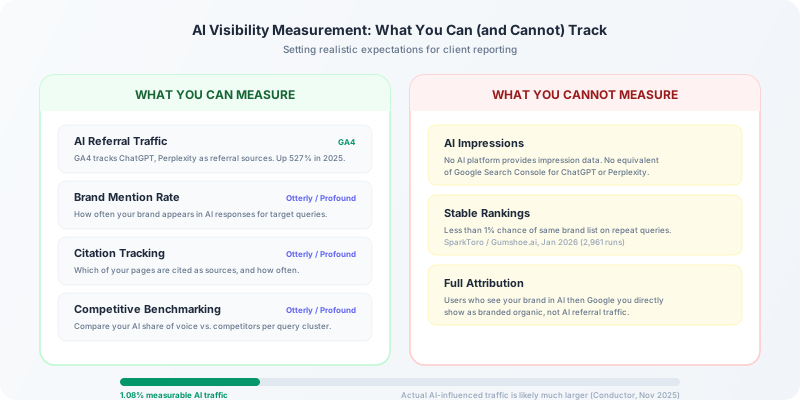
- AI referral traffic. ChatGPT, Perplexity, and other AI platforms show up as referral sources in GA4. ChatGPT drives 87.4% of all AI referral traffic (Conductor, November 2025). AI referral traffic surged 527% between January and May 2025 (BrightEdge / Previsible, August 2025). This is the most concrete metric you have.
- Brand mention rate. Tools like Otterly.AI, Profound, and Peec AI can track how often your brand appears in AI-generated responses across platforms. Otterly.AI covers ChatGPT, Perplexity, Google AI Overviews, Gemini, and Microsoft Copilot. This gives you a "share of voice" metric specific to AI search.
- Citation tracking. Which of your pages are being cited as sources in AI answers, and how often? This tells you which content is working and which is not.
- Competitive benchmarking. The same tools let you track competitors. If your client's competitor shows up in 60% of AI responses for a key query and your client shows up in 20%, that is a clear gap to close.
For a full metrics framework, see our guide to measuring AI visibility.
What You Cannot Measure (Be Honest About This)
- AI impressions. No AI platform provides impression data. There is no equivalent of Google Search Console for ChatGPT. You can probe AI platforms with queries and track what comes back, but that is a sample, not a census.
- Exact rankings. AI responses are not like Google's ten blue links. SparkToro and Gumshoe.ai tested this directly (January 2026, 600 volunteers, 2,961 query runs): AI tools returned the same brand recommendation list less than 1% of the time. The concept of a stable "#1 position" does not apply.
- Full attribution. Someone sees your brand recommended in ChatGPT, then Googles your brand name and visits your site. That shows up as branded organic search, not AI referral traffic. The influenced traffic is likely larger than the directly measurable traffic.
Our article on why GEO tracking is imperfect but worth doing provides a framework for explaining these limitations to clients without undermining the case for AI visibility work.
What Not to Promise
Here is what the research says you should not guarantee:
- "We will get you ranked #1 in ChatGPT." There is no stable #1. SparkToro's study found roughly 1-in-1,000 odds of getting the same ordered list twice. The right framing is "consideration set" (are you in the pool of brands AI recommends?) not "position" (are you first on the list?).
- "AI visibility will replace your lost organic traffic." AI referral traffic currently accounts for 1.08% of all website sessions across industries (Conductor, November 2025). Even with 527% growth, that does not replace the 33-38% of Google traffic that has already declined. AI visibility matters for brand perception and purchase influence, not as a direct traffic replacement.
- "Optimizing for one AI platform covers them all." Only 12% of URLs cited by ChatGPT, Gemini, and Copilot also rank in Google's top 10 for the same query (Ahrefs, September 2025). Google AI Overviews and Google AI Mode show only 10.7% URL overlap with each other (SE Ranking). Each platform uses different retrieval methods. Cross-platform monitoring is necessary, not optional.
- "Schema markup guarantees AI citations." A December 2024 Search/Atlas study found no direct correlation between schema markup coverage and citation rates when isolated from other factors. Schema is part of the toolkit, not a silver bullet.
How This Connects to What They Already Pay You For
Your client is probably thinking: "Is this replacing SEO and SEM? Do I need a separate budget?" The honest answer depends on which AI platforms matter to them.
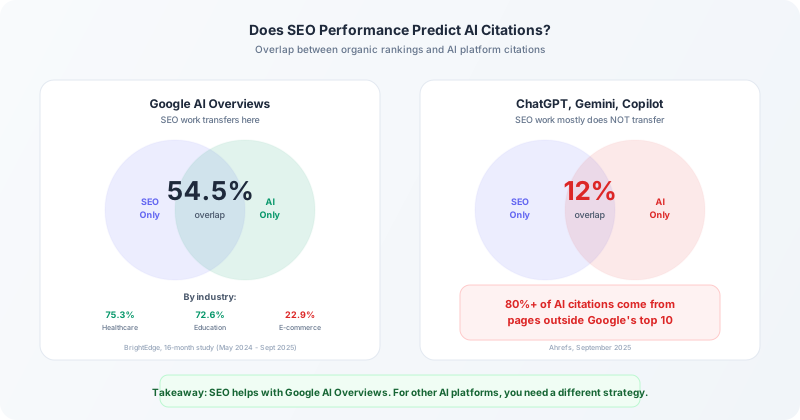
Google AI Overviews still favor organically ranked content. BrightEdge tracked AI Overview citation overlap with organic rankings over 16 months (May 2024 to September 2025) and found it grew from 32.3% to 54.5%. In trust-heavy verticals, the overlap is even higher: healthcare at 75.3%, education at 72.6%. If your client's priority is Google AI Overviews, existing SEO work transfers meaningfully.
Non-Google AI platforms are a different story. For ChatGPT, Gemini, and Copilot, Ahrefs found that more than 80% of citations come from pages that do not rank in Google's top 10 for the same query. Traditional SEO rankings have minimal predictive value for these platforms. Our analysis of why SEO rankings no longer predict AI citations covers this data in detail.
Paid search and AI visibility interact in unexpected ways. Paid CTR on queries with AI Overviews has crashed 68% (Seer Interactive, September 2025). But being cited in an AI Overview produces 91% more paid clicks. That means AI visibility and paid search amplify each other when you achieve citation. Some agencies have already increased brand keyword budgets by up to 20% to maintain visibility when AI answers feature competitor links (Digiday, 2025).
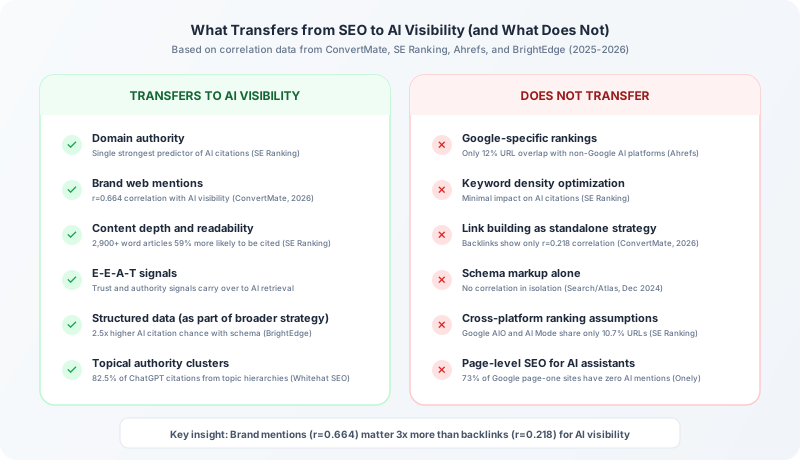
What transfers from existing SEO work: Domain authority (the single strongest predictor of AI citations per SE Ranking), content depth and readability, brand authority signals, and E-E-A-T signals. What does not transfer: Keyword density optimization (SE Ranking found minimal impact on AI citations), Google-specific rankings to non-Google AI platforms, and link building as a standalone strategy (backlinks show only r=0.218 correlation with AI visibility, far lower than brand mentions at r=0.664). For the full comparison, see our breakdown of which SEO tactics boost AI visibility and which do not.
The Starting Point
You do not need to pitch a full AI visibility program in the first meeting. Start with a baseline audit. Ask your client to pick their top 5 product or service queries, the ones that drive their business. Run those queries through ChatGPT, Perplexity, and Google (with AI Overviews). Document whether their brand appears, where it appears, and what competitors show up instead. That takes an afternoon, costs nothing, and gives you a concrete "here is where you stand" to present.
From there, the conversation becomes specific: "You show up in 2 out of 5 queries on ChatGPT and 0 out of 5 on Perplexity. Your competitor shows up in 4 out of 5 on both. Here is what we recommend." That is a much easier sell than abstract predictions about AI search trends.
Our AI visibility audit checklist provides a structured framework for running this baseline, and our platform prioritization guide helps you decide where to focus first based on your client's industry and audience.
What the Industry Is Investing
If your client asks whether other companies are taking this seriously: 56% of companies made significant AEO/GEO investments in 2025, 97% reported a positive impact, and 94% plan to increase those investments in 2026. On average, about 12% of digital marketing budgets are now allocated to AI visibility and optimization (Conductor State of AEO/GEO Report, 2025-2026). This is not a fringe activity. It is becoming a standard line item.
The Honest Framing
Here is the sentence that builds the most trust in a client meeting: "AI visibility is real, measurable, and growing. It is also early. We know what factors correlate with AI citations, but the platforms change frequently, measurement has gaps, and nobody can guarantee a specific placement. What we can do is establish your baseline, implement the tactics that have evidence behind them, and track your progress over time."
That is the answer your client needs. A clear-eyed assessment of where things stand, what to do about it, and what to watch for next.
Want more insights like this?
Get weekly AI visibility strategies, AEO guides, and platform updates delivered to your inbox.
No spam. Unsubscribe anytime.