ChatGPT Now Sells Ads at $3 to $5 Per Click. Here Is Everything We Know So Far.
OpenAI launched self-serve CPC ads inside ChatGPT with 600+ advertisers, $3 to $5 per click pricing, and a new ads manager. Here is how the ad platform works, what brands are paying, and what the early data shows.
On February 9, 2026, OpenAI started showing ads inside ChatGPT. Six weeks later, the pilot had crossed $100 million in annualized revenue with 600+ advertisers (CNBC, March 26, 2026). By mid-April, OpenAI launched a self-serve ads manager, dropped the minimum spend from $250,000 to $50,000, and introduced cost-per-click pricing at $3 to $5 per click (Digiday, April 21, 2026). ChatGPT is now an ad platform.
Here is what we know so far about ChatGPT's ad platform: how it works, what it costs, who sees ads, which brands are already in, and what the early performance data looks like.
How ChatGPT Ads Work Right Now
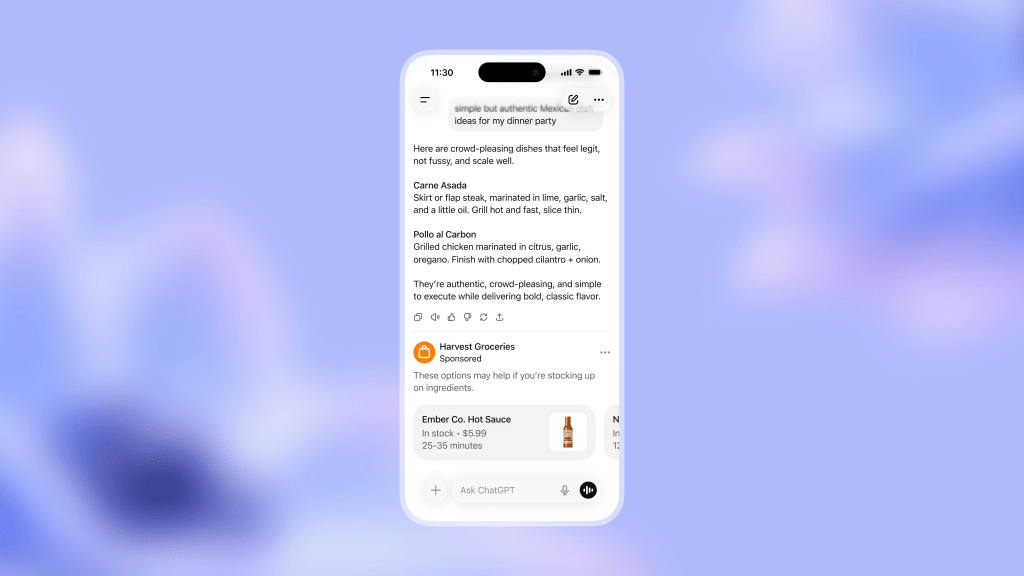
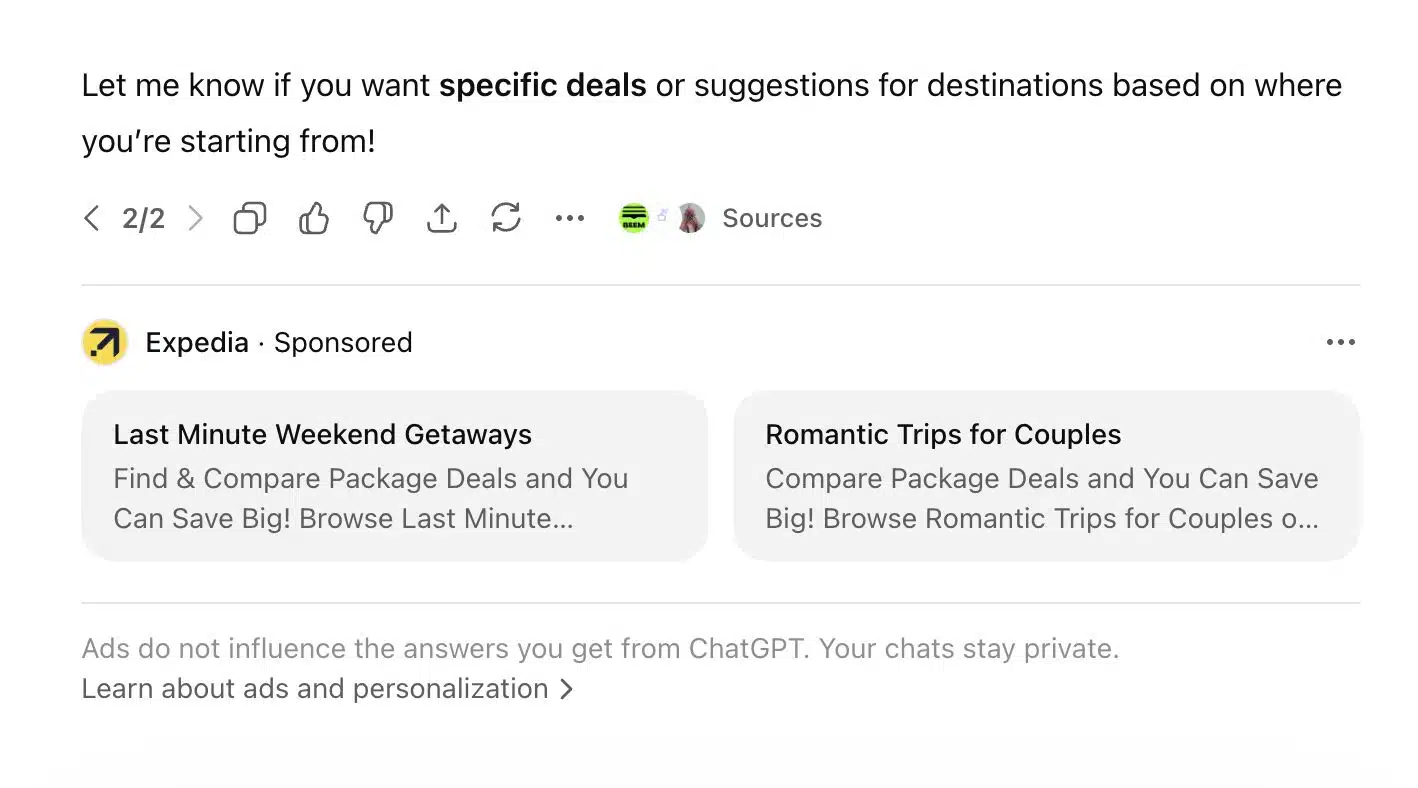
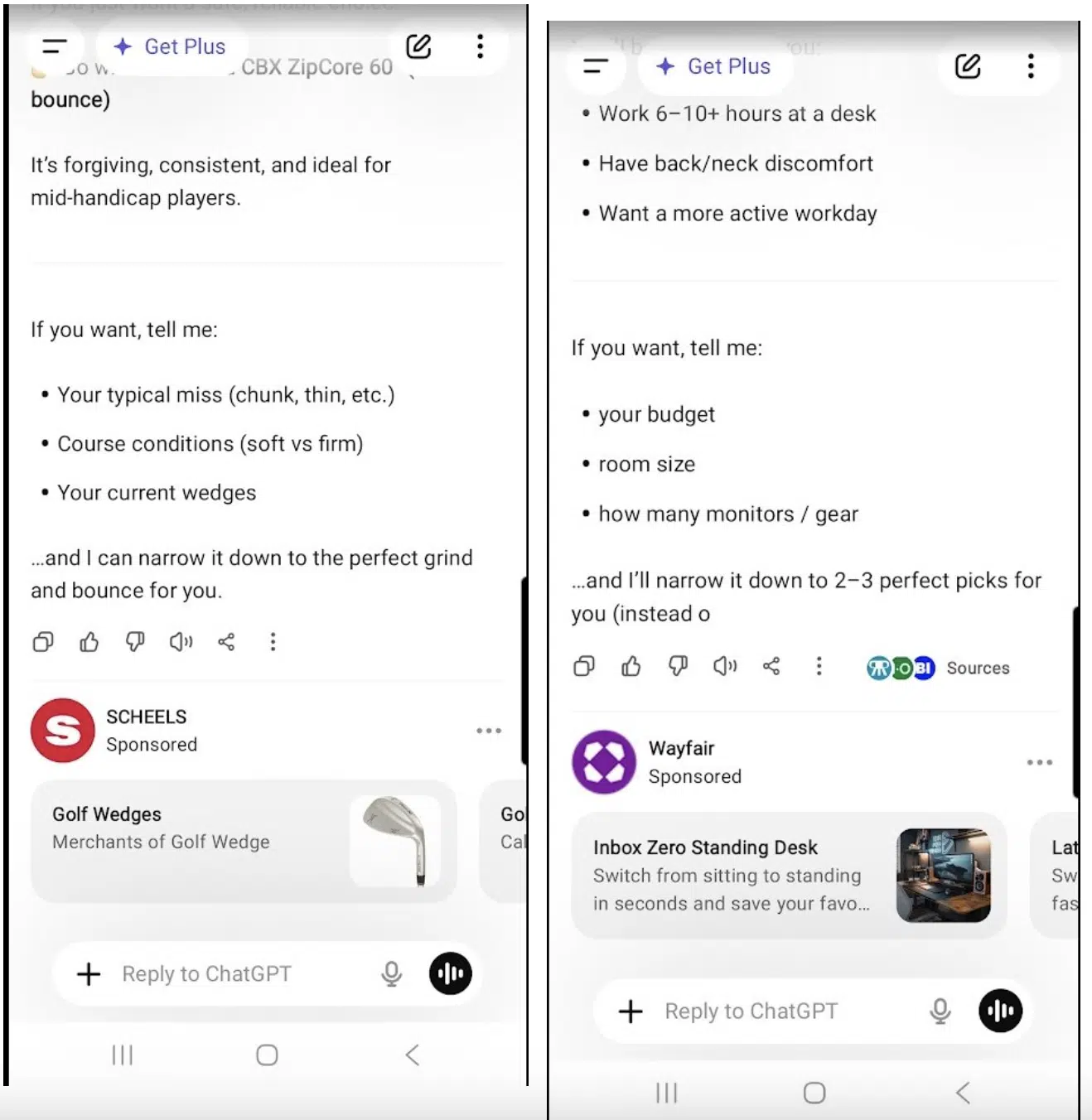
ChatGPT ads appear as sponsored cards below the AI-generated response, visually separated and labeled "Sponsored." They do not appear within the answer itself. Ad formats include text-based sponsored answer cards, product spotlight units with pricing and direct links, and contextual sidebar placements on the web interface (SingleGrain, 2026).
Ads currently appear in approximately 0.8% of ChatGPT responses, based on Adthena's analysis of over 500 prompts (Adweek, February 2026). That is an extremely conservative rollout compared to Google AI Overviews, where ads now appear alongside roughly 25% of all responses (AdventurePPC, 2026).
Who sees ads and who does not
Ads only appear for Free tier and Go tier ($8/month) users. Plus ($20/month), Pro, Business, Enterprise, and Education users never see ads (OpenAI Help Center). Free-tier users can also opt into an "Ads-Free" mode that removes ads but reduces daily message limits.
In terms of reach, free-tier users make up roughly 81% of ChatGPT's user base (Index.dev, 2026), so ads do reach the majority of users by volume. ChatGPT has approximately 50 million paying subscribers out of 800+ million weekly active users (Backlinko, 2026). However, paid subscribers engage 4.2x more frequently per week than free users, so they represent a disproportionate share of actual platform usage despite being the smaller segment.
The pricing timeline
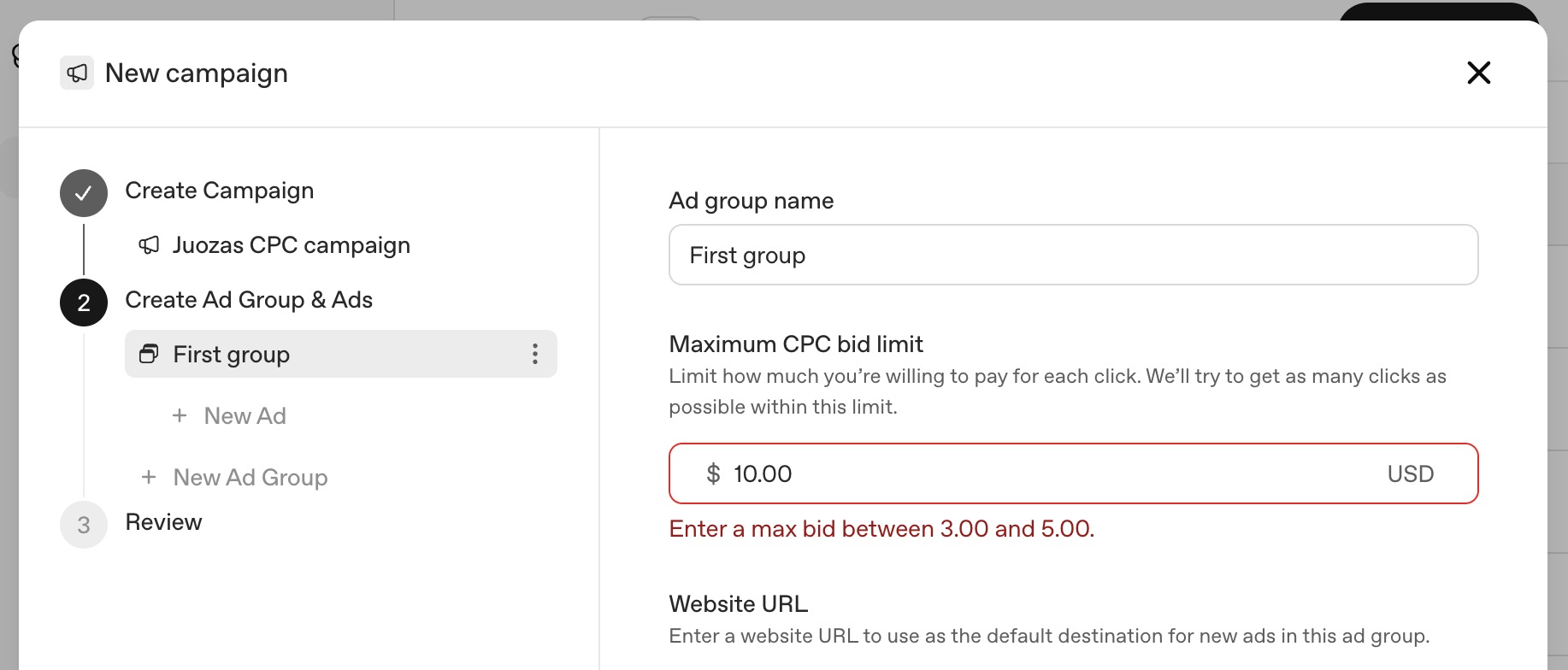
OpenAI launched with a $60 CPM (cost per thousand impressions) and a $200,000 to $250,000 minimum spend. Within ten weeks, CPMs eroded to $25, and a leaked StackAdapt deck showed rates as low as $15 (Digiday, April 17, 2026; TheNextWeb, April 2026). In response, OpenAI introduced CPC bidding at $3 to $5 per click and dropped the minimum spend to $50,000.
For context, those CPMs are still well above most social platforms. Facebook averages $4.82 CPM, Instagram $7.63, and TikTok $3.02 (Digiday). LinkedIn is the closest comparison at $39.19 CPM. The CPC range of $3 to $5 positions ChatGPT ads in Google Search territory.
The Self-Serve Ads Manager
OpenAI's self-serve ads manager launched around April 15, 2026. It uses a three-tier hierarchy (Campaigns, Ad Groups, Ads) that mirrors Google Ads and Meta's structure (ppc.land, April 2026). Each ad unit includes a headline, short description, and optional square image. Video is not yet supported.
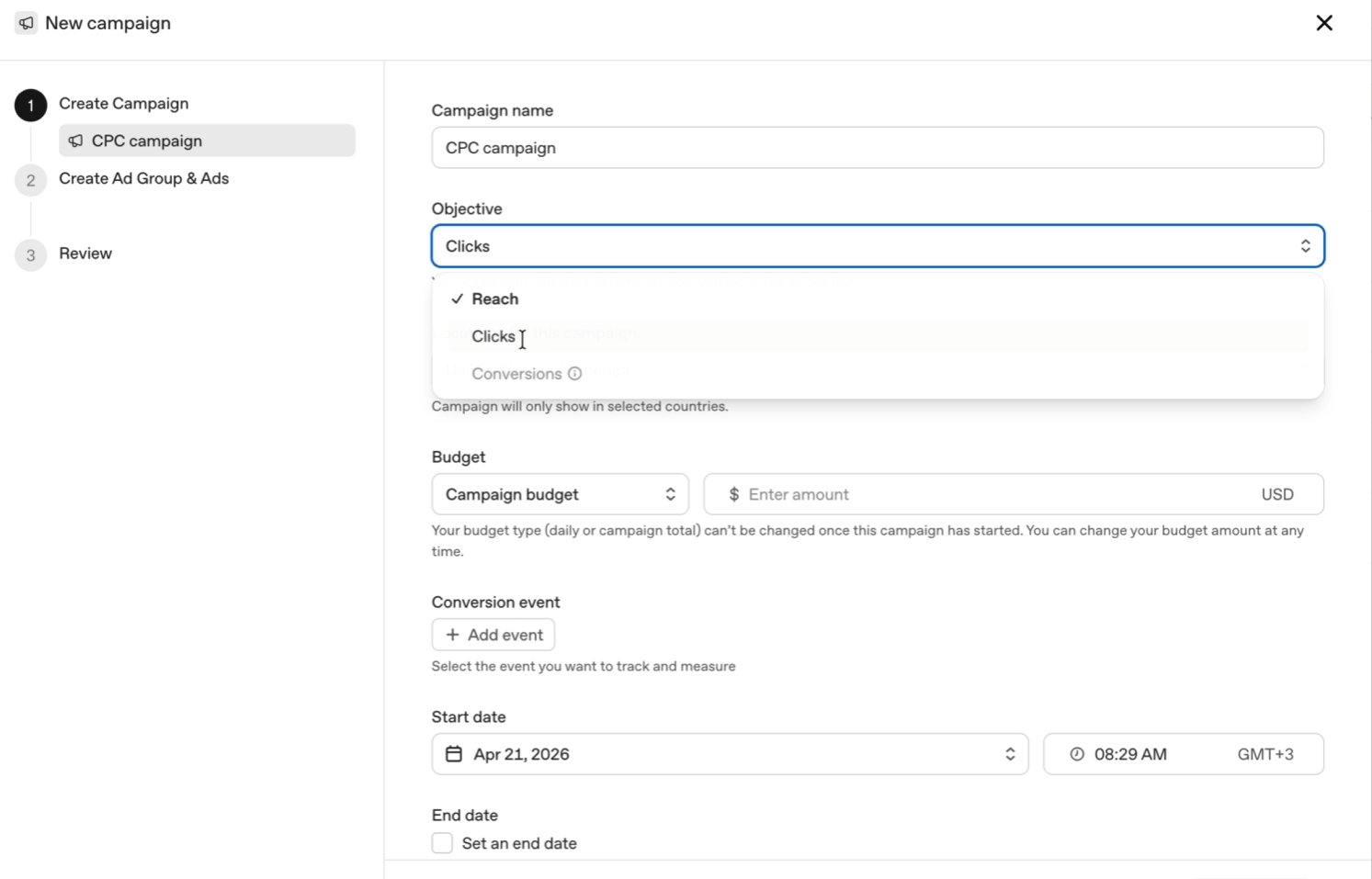
Targeting works differently from traditional ad platforms. Instead of demographic or behavioral segments, advertisers enter "context hints," plain-language descriptions of when their ad should appear. Only country-level geographic targeting is currently available. Campaign objectives include Reach (CPM-based, live), Clicks (coming soon), and Conversions (coming soon) (ppc.land, April 2026).
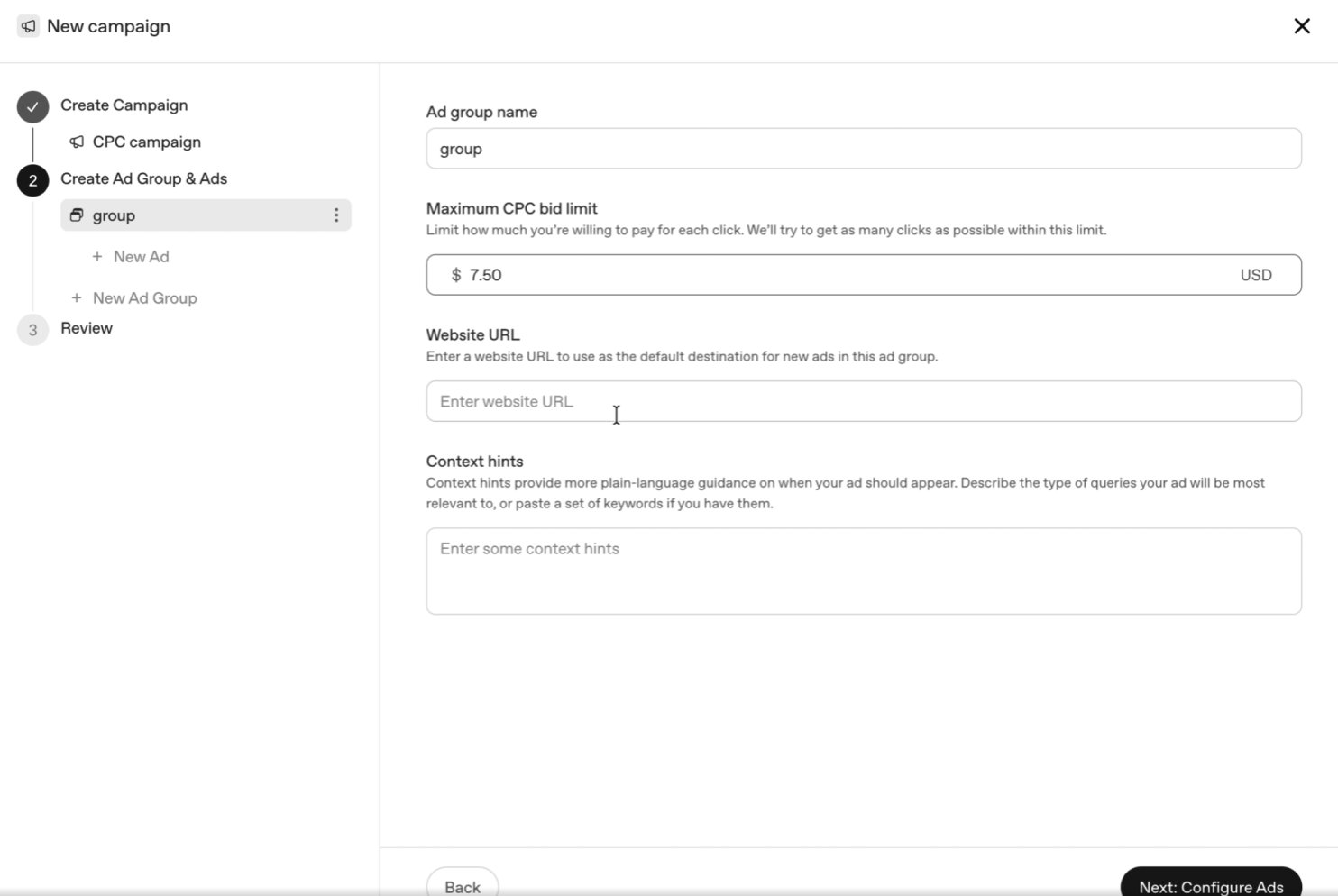
OpenAI has also built a conversion tracking pixel that supports lead creation, order creation, and subscription start events. Criteo (announced as OpenAI's first ad tech partner on March 2, connecting 17,000 advertisers) and Smartly are building conversational ad formats beyond static placements (Criteo press release, March 2, 2026).
Which Brands Are Already Advertising
The pilot launched with Best Buy, Expedia, Enterprise Mobility, Qualcomm, and The Knot Worldwide (Adweek, February 2026). Agency holding companies Dentsu, Omnicom, and WPP brought in additional brands including Adobe, Audible, Ford, Mazda, Target, Williams-Sonoma, AT&T, and Audemars Piguet (Tom's Guide, 2026). Over 600 advertisers were in the pilot by late March (CNBC).
The "Answer Independence" Principle
OpenAI has formally stated that ads and organic responses operate on separate systems. From their blog post: "No advertiser can pay to be included in, excluded from, or featured more prominently within an organic AI response." They describe this as an editorial independence standard analogous to major journalism outlets (OpenAI, "Our approach to advertising and expanding access to ChatGPT").
Asad Awan, OpenAI's ads and monetization lead, told Adweek: "We believe ads play an important role in continuing to support broad access to AI. By working closely with partners in this pilot, we are able to thoughtfully test new ad experiences and learn together to ensure ads are separate and clearly distinct, relevant, and useful while maintaining the trust people place in ChatGPT."
Whether that wall holds long-term is the question nobody can answer yet. OpenAI is projecting a $14 billion loss in 2026 (TheNextWeb) and has shared investor projections of $2.5 billion in ad revenue for 2026, scaling to $100 billion by 2030 (Axios, April 9, 2026). The financial incentive to blur the line between paid and organic will only grow.
Early Performance Data
Performance data is still limited, but here is what has been reported:
- Click-through rate: Estimated at 0.5% to 1.0% for well-targeted campaigns (AdventurePPC, 2026). For comparison, overall ChatGPT link CTR (organic, not ads) is approximately 1.3% (Ahrefs, ppc.land), while Google Search averages 29.2%.
- Conversion rate: Criteo reports that LLM-referred users convert at approximately 1.5x the rate of users from other referral channels (Criteo press release, March 2026). Projected conversion rates range from 1.1% to 6.0% depending on industry.
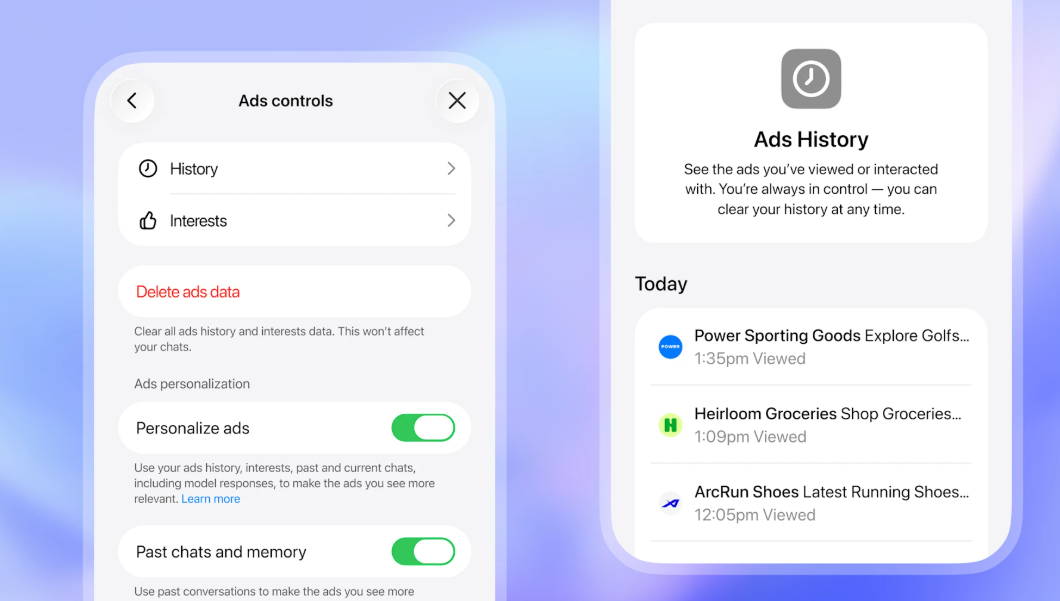
- User trust: Two-thirds of US adults distrust AI search ads, according to an Ipsos survey (TheNextWeb, 2026). That skepticism could limit ad effectiveness or, conversely, make organic citations even more valuable by comparison. Users can manage their ad experience through ChatGPT's Ads Controls panel, which includes options for ad history, interest-based personalization, and the ability to delete all ads data.
- Measurement gap: Robert Webster of TAU told Digiday that advertisers currently lack independent verification of impression value and are relying on "OpenAI's word for it." OpenAI is hiring its first Advertising Marketing Science Lead to build attribution models, incrementality testing, and media mix modeling (Digiday, April 21, 2026).
How Each AI Platform Is Handling Ads Differently
Three major AI platforms have taken three completely different approaches to advertising:
ChatGPT: CPC ($3-5) and CPM ($25-60) ads for Free/Go tier users. 600+ advertisers. Self-serve ads manager live. "Answer Independence" wall between paid and organic. Projecting $2.5 billion in ad revenue for 2026.
Google AI Overviews: Ads integrated into the existing Google Ads ecosystem. Ads now appear in approximately 25% of AI Overview responses (AdventurePPC, 2026), up from 5.17% in early 2025. Google reaches 2 billion monthly users across 200 countries versus ChatGPT's 800 million weekly active users. Google launched shopping ads with Direct Offers inside AI Mode in February 2026.
Perplexity: Abandoned advertising entirely in February 2026 after testing "Sponsored follow-up questions" throughout 2024-2025. Cited user trust concerns as the primary reason. Now targeting $500 million in annualized subscription revenue, positioning as the ad-free alternative (PYMNTS, 2026).
This three-way split matters. Each platform treats paid and organic content differently, which means brands need to think about their AI presence on a platform-by-platform basis rather than as a single channel.
What This Means for Organic AI Visibility
The arrival of paid ads inside ChatGPT has a secondary effect worth noting: it makes organic citations more distinct. Paid placements only reach free-tier users (81% of the base by volume, but lower by engagement). Organic citations appear within the answer itself, across all user tiers, and they work on every AI platform, not just ChatGPT. Two-thirds of US adults distrust AI search ads (Ipsos), so organic mentions carry a different trust signal than a labeled "Sponsored" card.
OpenAI says ads and organic are architecturally separate. But multiple analysts note there is no public documentation describing whether monetization signals influence retrieval systems, source selection, or ranking logic at any level (Zen Media, 2026). Google AI Overviews are reportedly 44% more likely to contain negative brand mentions than ChatGPT (Fortune, March 12, 2026). The honest answer is: we do not know yet how these systems will evolve.
The Revenue Context: Why This Matters Long-Term
OpenAI's total annualized revenue passed $20 billion by January 2026 (CFO Sarah Friar, CNBC). But they project a $14 billion loss for the year. Ad revenue is not a nice-to-have; it is essential to the business model. The investor projections tell the story: $2.5 billion in 2026, $11 billion in 2027, $25 billion in 2028, $53 billion in 2029, $100 billion by 2030 (Axios, April 9, 2026). Those projections assume OpenAI's products reach 2.75 billion weekly users.
OpenAI hired Shivakumar Venkataraman, a 21-year Google veteran who led Google's search ads business, as VP in June 2024 (The Information). They recently brought on Michael Tabtabai as their first global creative chief (Ad Age). The company is building a serious advertising operation, not running a small experiment.
For brands considering ChatGPT ads, the implication is straightforward: this is a real ad platform with staying power, not a limited experiment. The question is whether the current targeting capabilities, performance data, and measurement infrastructure justify the spend for your specific use case.
The Bottom Line
ChatGPT's ad platform went from zero to $100 million ARR in six weeks, with 600+ advertisers, a self-serve manager, and CPC pricing that puts it in Google Search territory. The infrastructure is real: conversion tracking, context-hint targeting, Criteo as a tech partner, and a leadership team pulled from Google's ads division.
The limitations are also real: ads reach only free-tier users (81% of the base, but lower-engagement users), appear in fewer than 1% of responses, and lack independent measurement verification. Early advertiser trust is mixed, with CPMs already eroding from $60 to $25 within ten weeks.
For brands evaluating whether to advertise on ChatGPT, the platform is still early. For brands thinking about overall AI visibility, the key takeaway is that paid and organic now coexist inside ChatGPT, with very different reach profiles. Ads get your link in front of free-tier users. Organic citations get your brand into the answer for everyone.
Want more insights like this?
Get weekly AI visibility strategies, AEO guides, and platform updates delivered to your inbox.
No spam. Unsubscribe anytime.