ChatGPT Ads Dropped the $50K Minimum. Here Is What the Self-Serve Platform Looks Like.
On May 5, 2026, OpenAI launched a self-serve ads manager, eliminated the minimum spend, added CPC bidding, and shipped conversion tracking. Two weeks in, here is what the platform includes, what is still missing, and what it means for advertisers.

On May 5, 2026, OpenAI made the biggest change to its ad platform since launch. They opened a self-serve ads manager, eliminated the minimum spend entirely, added cost-per-click bidding, and shipped conversion tracking tools that let advertisers measure what happens after someone clicks an ad (OpenAI Blog, May 5, 2026). The platform that required a $50,000 commitment and a sales conversation in April is now open to any US business with a credit card. Two weeks in, here is what the self-serve platform actually includes.
Here is what changed, what the new tools do, and what it means for the ChatGPT advertising landscape.
The Minimum Spend Is Gone
The spending threshold has been eliminated entirely. For context, here is how quickly it dropped: when OpenAI first started testing ads with select partners in late 2025, the minimum commitment was reportedly $200,000 (Digiday, 2026). By mid-April 2026, it was reduced to $50,000 with the launch of the self-serve ads manager beta. As of May 5, there is no minimum at all.
This is the change that matters most for the competitive landscape. When ChatGPT advertising required $50,000, it was limited to enterprise brands and agencies. Now SMBs, startups, and mid-market companies can test the platform. OpenAI VP Benji Shomair said the company is "taking a deliberately conservative approach, as we ensure that we're delivering a good experience for users" (AdExchanger, May 2026).
What the Self-Serve Ads Manager Includes
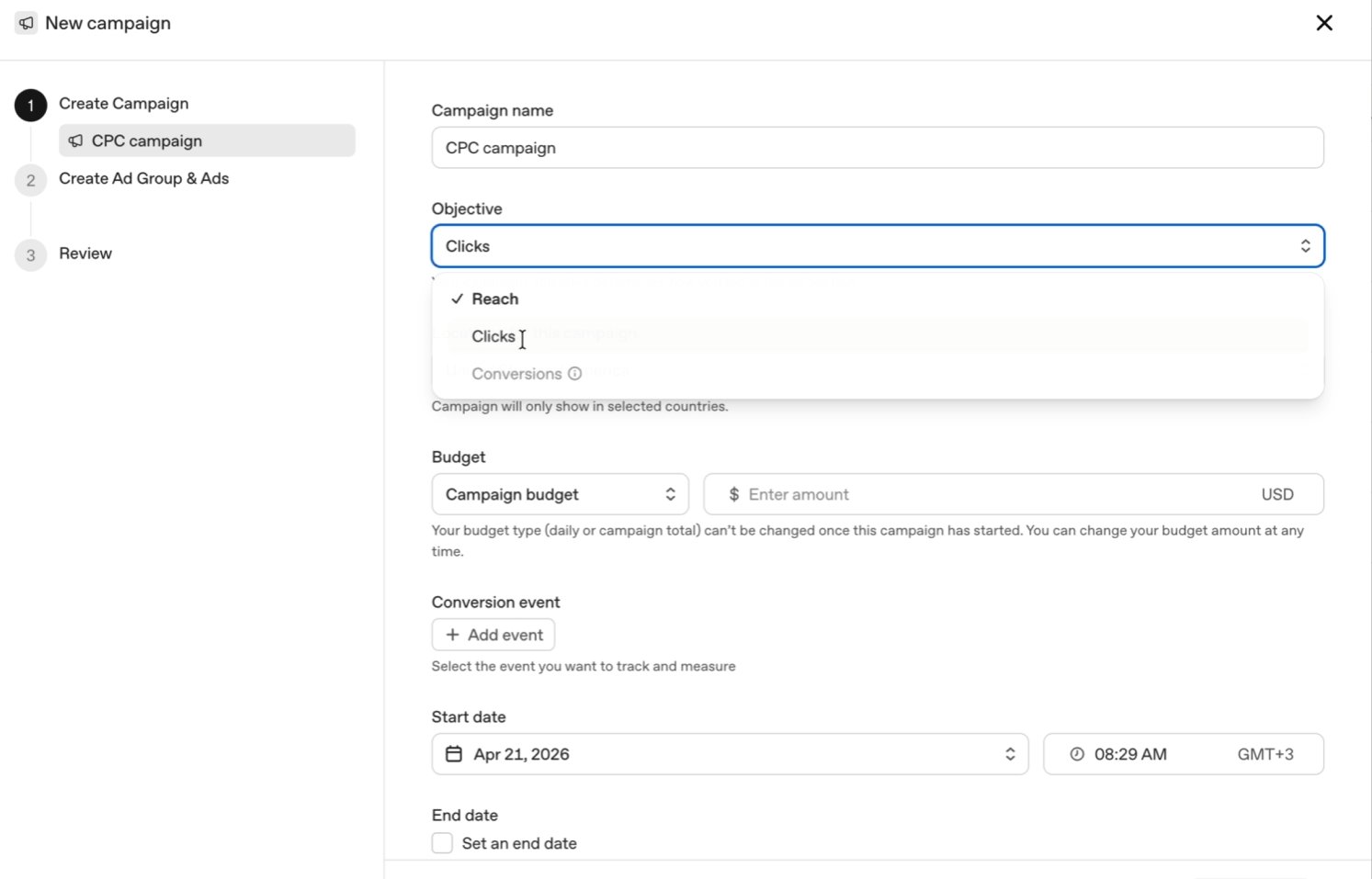
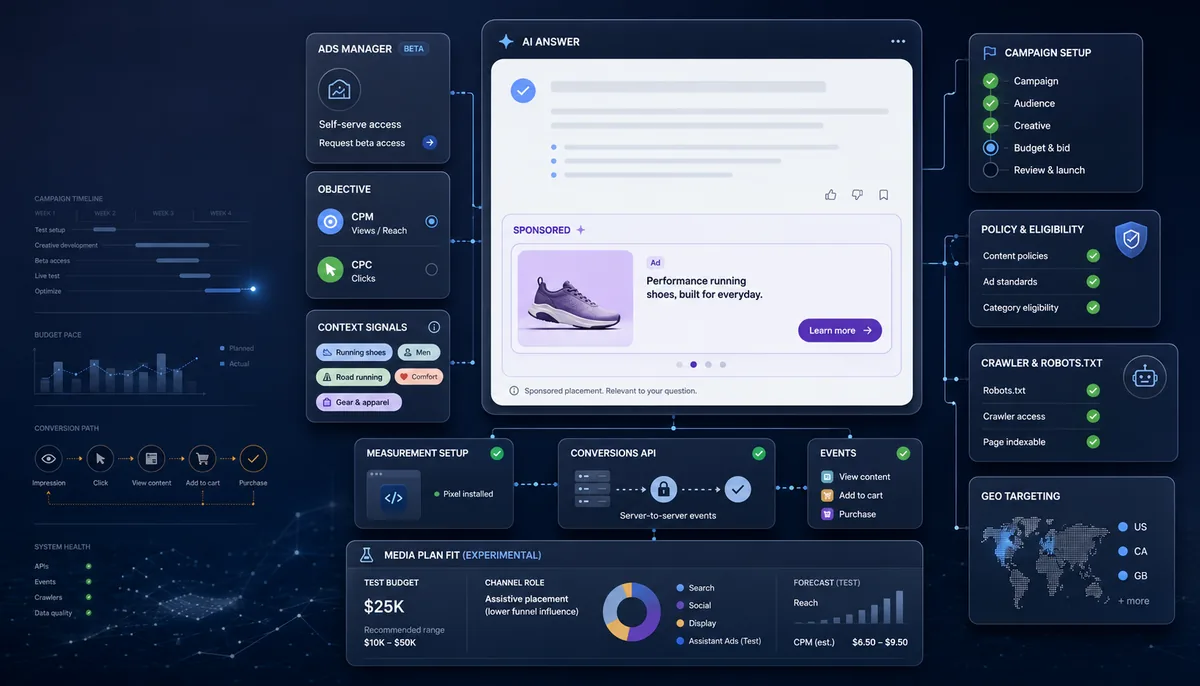
The ads manager is available to US-based advertisers and supports guided campaign creation, bulk upload, performance monitoring, inline and bulk edits, member permissions, billing management, and API keys (Choice OMG, May 2026). The interface is designed to feel familiar to anyone who has used Google Ads or Meta Ads Manager.
Bidding options
There are now two bidding models available. CPM (cost per thousand impressions) has a default max bid of $60, though observed real-world pricing has dropped to approximately $25 as inventory expanded (Choice OMG, 2026). CPC (cost per click) was added in the May 5 update with a recommended starting max bid of $3 to $5. Both operate through relevance-weighted, second-price auctions where the bid is one input alongside ad and landing-page relevance.
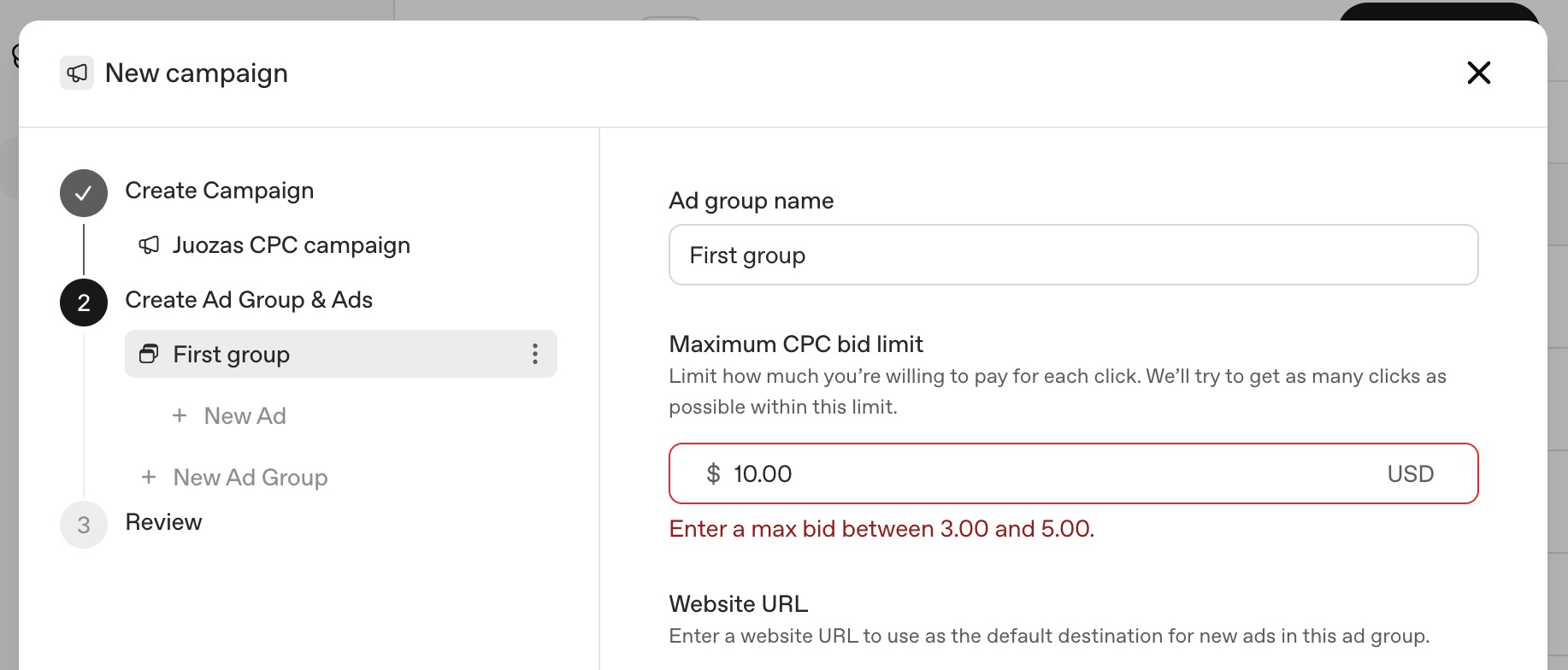
CPA (cost per action) bidding is "in motion" according to Asad Awan, OpenAI's ads lead, but no timeline has been confirmed (Digiday, May 2026).
Conversion tracking
This is the most significant technical addition. OpenAI shipped two measurement tools simultaneously:
- OAIQ Pixel (v0.1.3): A browser-side tracking pixel that sets a first-party cookie with a 30-day lifetime. It tracks page views, purchases, searches, cart additions, signups, and leads (Choice OMG, 2026).
- Conversions API: A server-to-server measurement tool that tracks web, mobile app, offline, physical store, phone call, and email action sources. It includes deduplication via event ID to avoid double-counting (Choice OMG, 2026).
Before May 5, there was no way for advertisers to track what happened after someone clicked a ChatGPT ad. That was the single biggest complaint from early pilot participants. Now advertisers can attribute purchases, leads, and sign-ups to specific ad interactions. OpenAI states it only shares aggregated data and does not share individual conversation content with advertisers (The Decoder, May 2026).
What is still missing: view-through metrics, configurable attribution windows, marketing mix modeling (MMM) hooks, lift studies, and third-party measurement verification. Awan acknowledged that third-party measurement partnerships are planned but "the company doesn't have partners or an exact timeline" (Digiday, May 2026).
Creative format
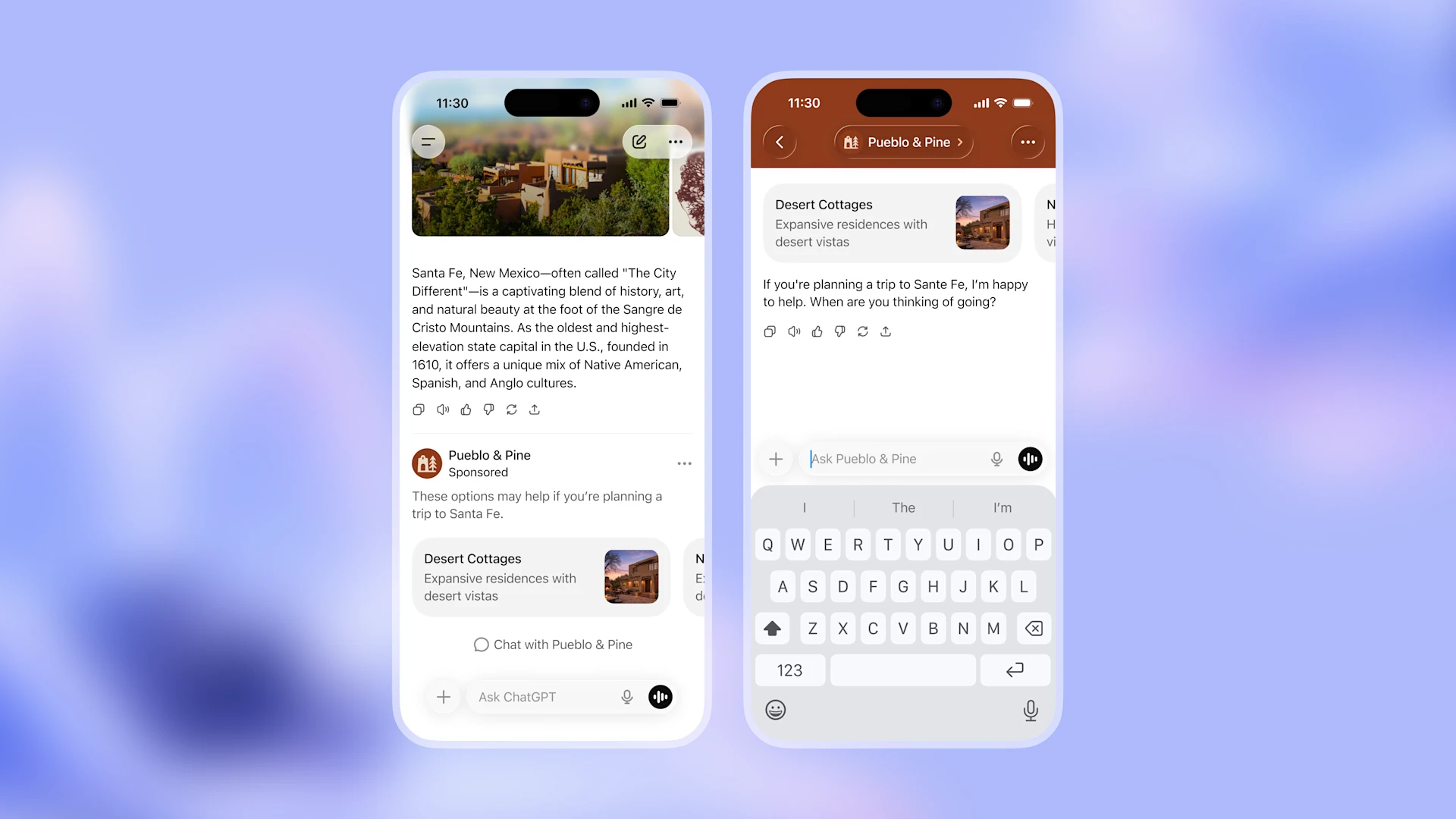
The ad format remains limited to a single type: a "chat_card" with a 3 to 50 character title, up to 100 characters of body copy, an image, a favicon, and a target URL. No video, carousel, or interactive ad formats are available yet (Choice OMG, 2026). Image and video formats are reportedly in development.
Product feed ads (coming)
OpenAI announced product feed-based advertising tools that will let e-commerce retailers generate ads directly from their existing product catalogs. Retailers will be able to connect a catalog, select which products are eligible for advertising, and have the platform auto-generate ads using product names, images, and catalog attributes. The system supports up to one million SKUs per advertiser, and new partners must submit 100 sample products before getting full catalog access (Marketing Tech News, May 2026). No public launch date has been announced.
Who Can Advertise and Where Ads Appear
The self-serve ads manager is open to US-based businesses of all sizes. Ads appear to Free and Go tier users in the United States, Canada, Australia, and New Zealand. Ads are blocked entirely from sensitive conversation contexts including child safety, self-harm, hate speech, weapons, mental health, and political topics (Choice OMG, 2026).
The category restrictions are significant. OpenAI is being selective about which industries can advertise, and several major verticals are excluded entirely.
Allowed ad categories
- Lifestyle and consumer goods
- Household goods
- Local services
- Travel and hospitality
- Digital products and software
- Education
Prohibited ad categories
- Financial services (banking, lending, insurance, investment, cryptocurrency)
- Healthcare and pharmaceuticals (prescription drugs, medical devices, health claims)
- Legal services (law firms, legal advice)
- Alcohol and drugs (including cannabis where legal)
- Gambling and betting
- Dating and adult content
- Political campaigns and advocacy
- Weapons and ammunition
These restrictions mean that several of the largest digital ad-spending categories cannot use ChatGPT ads at all. Financial services alone accounts for over $30 billion in annual US digital ad spending (eMarketer, 2026). Healthcare, legal, and gambling are similarly major ad categories on Google and Meta. OpenAI has not indicated whether or when these restrictions will be loosened, though the company has framed them as part of its "deliberately conservative approach" to the ad rollout (AdExchanger, May 2026).
OpenAI confirmed that global expansion to the UK, Japan, Brazil, Mexico, and South Korea is planned but has not provided specific dates (OpenAI, 2026).
Agency and Technology Partners
Four major agency holding companies have early access: Dentsu, Omnicom, Publicis, and WPP. Five ad-tech partners are integrated: Criteo (the first integration partner), Adobe, Kargo, Pacvue, and StackAdapt. These partnerships let advertisers book ChatGPT ads through existing tools and combine them with campaigns across other channels (The Decoder, May 2026).
Criteo reported that LLM-referred traffic converts at roughly 1.5x the rate of other referral channels across a sample of 500 retailers (Choice OMG, 2026). This is a notable data point, though it measures organic LLM referrals generally, not paid ChatGPT ad clicks specifically.
What the Inventory Actually Looks Like
One of the ongoing issues is limited ad inventory. During the pilot phase, fewer than 20% of eligible users were shown ads on any given day (Choice OMG, 2026). Ads appeared in approximately 0.8% of all responses. Early advertisers struggled to spend their allocated budgets because there simply were not enough ad placements (AdExchanger, 2026). OpenAI says fill rates have improved through better relevance matching.
The inventory constraint also affects pricing. CPMs dropped from $60 at launch to approximately $25 within ten weeks. That erosion reflects either improving supply, weakening demand, or both. For comparison, LinkedIn averages $39.19 CPM, Instagram $7.63, and Facebook $4.82.
The Revenue Targets Behind the Expansion
The speed of this rollout makes more sense in context of OpenAI's financial targets. The US pilot generated over $100 million in annualized revenue within six weeks of launch (CNBC, March 2026). OpenAI is targeting $2.5 billion in ad revenue for 2026, scaling to $100 billion by 2030 (Axios, April 2026). The company projects a $14 billion loss for the year, making ad revenue an essential part of the business model.
Removing the minimum spend and launching self-serve access are straightforward moves to expand the advertiser base. With 900 million weekly active users and only Free and Go tier users (approximately 81% of the base) seeing ads, ChatGPT has substantial untapped ad inventory that it needs more advertisers to fill.
What This Means If You Are Considering ChatGPT Ads
The May 5 update changes the practical calculus for advertisers in three ways:
- The barrier to entry is gone. Any US business can now test ChatGPT ads without a $50,000 commitment or a sales conversation. CPC bidding at $3 to $5 per click means you can run a meaningful test for a few hundred dollars.
- Measurement now exists. With the OAIQ pixel and Conversions API, advertisers can track purchases, leads, and sign-ups for the first time. This was the single biggest gap in the platform before May 5. It is still early (no third-party verification, no view-through tracking, no attribution windows), but it is a real measurement stack.
- The platform is still inventory-constrained. Ads appear in fewer than 1% of responses, and fewer than 20% of eligible users see ads daily. If you are looking for scale, ChatGPT is not there yet. If you are looking for high-intent, low-competition inventory while the platform is still early, this is the window.
The Bottom Line
Between mid-April and May 5, ChatGPT ads went from a $50,000-minimum pilot with no measurement tools to an open self-serve platform with CPC bidding, conversion tracking, and no spending floor. The ad format is still limited (text cards only), inventory is still thin (sub-1% of responses), and third-party measurement verification does not exist yet.
But the trajectory is clear. OpenAI is building a full advertising platform at an unusually fast pace: $200K minimum in late 2025, $50K in April 2026, $0 in May 2026. CPA bidding, product feed ads, image and video formats, global expansion, and third-party measurement are all on the roadmap. For brands in allowed categories (lifestyle, travel, digital products, education), there is now no financial barrier to testing.
Want more insights like this?
Get weekly AI visibility strategies, AEO guides, and platform updates delivered to your inbox.
No spam. Unsubscribe anytime.