Microsoft Just Shipped the AI Visibility Tool Google Won't Build
Bing Webmaster Tools now shows exactly which pages get cited for which AI queries. It is the first search engine to offer page-level AI citation analytics. Here is what it shows, how to use it, and why it matters.
One of the biggest challenges in AI visibility optimization has been measurement. You can optimize your content for AI citations, but how do you know which pages are actually being cited, and for which queries? Google Search Console does not show this data. Third-party tools offer estimates. Until now, no search engine gave you direct, first-party AI citation analytics.
That changed on March 23, 2026, when Microsoft rolled out a major update to the AI Performance dashboard in Bing Webmaster Tools: bidirectional grounding query-to-page mapping.
What Microsoft Launched
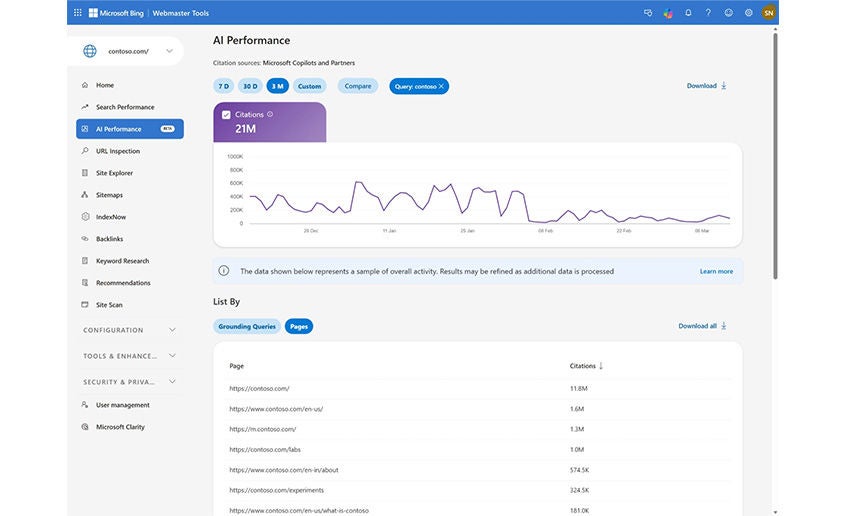
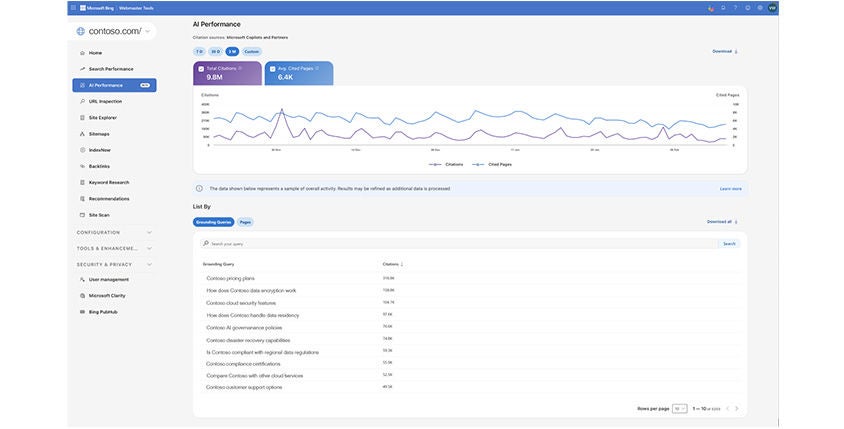
The update adds two new views to the existing AI Performance dashboard, which Microsoft originally introduced in late 2025 to show basic AI impression and click metrics:
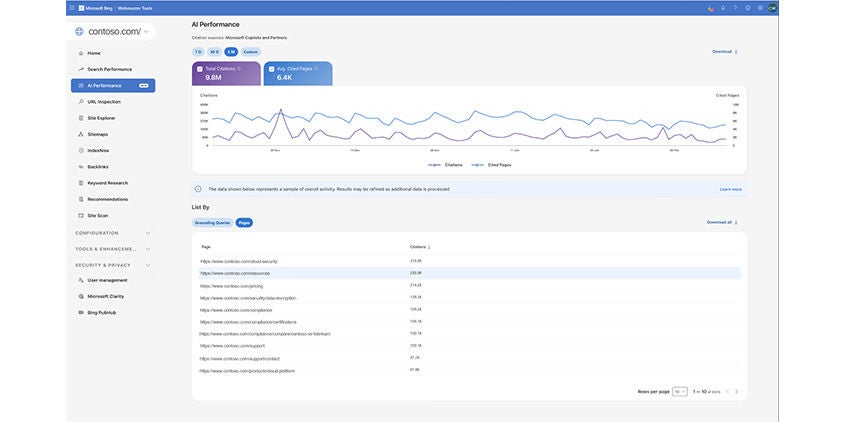
- Query-to-page mapping: For any AI query (called a "grounding query") that triggered a citation to your site, you can now see exactly which page or pages were cited.
- Page-to-query mapping: For any page on your site, you can see all the AI queries that cited it.
The relationship is many-to-many. A single grounding query can cite multiple pages from your site, and a single page can be cited by dozens of different queries. According to Search Engine Land's coverage, this covers citations across Microsoft Copilot, Bing AI answers, and partner integrations.
What "Grounding Queries" Are
Microsoft uses the term "grounding query" to describe the AI system's internal search query that retrieves your page as a source. This is different from what the user types. When someone asks Copilot "what are the best project management tools for small teams?", the AI may generate several grounding queries behind the scenes, similar to Google's query fan-out mechanism.
The dashboard shows you these grounding queries, not the user's original prompt. This distinction matters because it reveals the specific terms and topics the AI system associated with your content. If your page about "marketing automation platforms" is being cited via grounding queries about "email drip campaign tools," that tells you something important about how AI systems categorize your content.
What Data the Dashboard Shows
The AI Performance dashboard now displays several metrics:
- AI impressions: How many times your site appeared as a citation in AI-generated responses.
- AI clicks: How many times users clicked through to your site from an AI citation.
- Grounding queries: The specific queries that led the AI to cite your pages.
- Cited pages: Which pages on your site are being used as sources.
- Query-page relationships: The bidirectional mapping showing which queries cite which pages and vice versa.
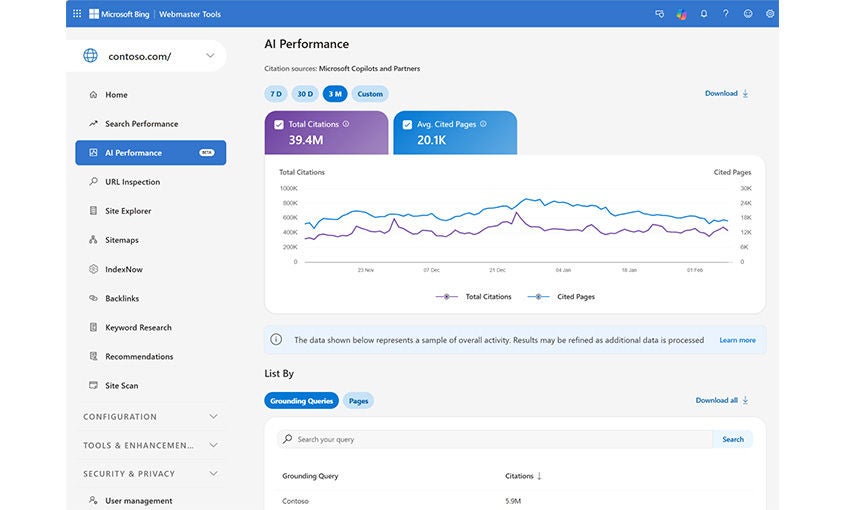
According to Search Engine Journal, the data covers a rolling window and updates regularly, similar to how traditional Bing Webmaster Tools data refreshes.
Why This Matters
This is the first time any major search engine has offered granular, page-level AI citation analytics. To understand why that is significant, consider what you currently cannot see:
- Google Search Console does not show AI Overview citation data. You cannot see which pages Google's AI cites or for which queries. Google has not announced plans to add this.
- ChatGPT / OpenAI does not offer any publisher-facing analytics. There is no way to see how often your content is cited in ChatGPT responses.
- Perplexity does not offer publisher dashboards. Some data is visible through third-party tools, but nothing first-party.
Microsoft is currently the only search engine giving site owners direct visibility into how their content feeds AI responses. Even if Bing represents a smaller share of search traffic than Google, the analytics data is applicable beyond just Copilot. ChatGPT uses Bing's search index for its web search feature. If your content is being cited by Copilot for certain queries, similar content patterns likely perform well across ChatGPT and other Bing-powered AI products.
How to Use This Data
Here are specific workflows that the new dashboard enables:
1. Find Your Most AI-Cited Pages
Use the page-to-query view to identify which of your pages get cited most frequently. These are your AI visibility winners. Study what makes them different: Are they more data-rich? Better structured? More frequently updated? Use those patterns as a template for other content.
2. Discover Unexpected Grounding Queries
Look at the grounding queries citing your top pages. You will likely find queries you did not expect. If your page about "CRM software comparison" is getting cited for grounding queries about "sales pipeline automation," that signals an opportunity to create dedicated content about sales pipeline automation, or to expand that section of your existing page.
3. Identify Content Gaps
If a grounding query cites your page but the match feels weak (the query topic is tangential to your actual content), that is a gap. The AI cited you because nothing better was available. Create targeted content for that specific topic, and you will likely strengthen your citation for that query while freeing up your original page to be cited more precisely for its core topic.
4. Track AI Visibility Over Time
Use the dashboard to establish a baseline for your AI impressions and clicks. Then measure the impact of content changes. Did adding an FAQ section increase citations? Did restructuring headings change which grounding queries cite you? This is the first time you can measure GEO tactics with first-party data, rather than relying solely on third-party estimates.
5. Cross-Reference with Organic Rankings
Compare your AI-cited pages with your organic ranking data. Research shows that only 38% of AI Overview citations come from top-10 ranked pages (Ahrefs, February 2026). The Bing dashboard lets you see this pattern firsthand: which of your pages are getting AI citations despite not ranking well organically, and vice versa?
How to Access It
The AI Performance dashboard is available in Bing Webmaster Tools for any verified site. If you have not set up Bing Webmaster Tools, the process is straightforward:
- Go to bing.com/webmasters and sign in with a Microsoft account.
- Add your site and verify ownership (DNS, meta tag, or CNAME verification).
- Once verified, navigate to the AI Performance section in the left sidebar.
- The query-to-page and page-to-query views are available within the AI Performance dashboard.
If you already have Bing Webmaster Tools set up, the new views should be available immediately. No additional configuration is needed.
Other Tools for AI Citation Tracking
Bing Webmaster Tools is the only first-party source, but several third-party tools offer complementary AI visibility data:
- Ahrefs Brand Radar: Tracks AI citations across platforms. This is the tool behind the 863,000-keyword study showing the decoupling of organic rankings from AI citations.
- Semrush AI Toolkit: Monitors AI Overview appearances and citation patterns. Tracks which competitor domains get cited for your target keywords.
- BrightEdge AI Catalyst: Enterprise-grade AI visibility tracking across multiple platforms. Their Generative Parser tracks citation overlap by industry.
- Otterly.AI: Focused specifically on AI search tracking. Monitors brand mentions across ChatGPT, Perplexity, Google AI, and Claude.
For a detailed comparison, see our independent review of GEO tools in 2026.
Will Google Follow?
Google has not announced any plans to add AI citation data to Google Search Console. Given that Google's AI Overviews now serve 2 billion monthly users and AI Mode has crossed 75 million daily active users (per Google's own reporting), the absence of publisher-facing AI analytics is notable.
Google's public position on AI Overviews and publisher traffic has been that cited brands see higher click-through rates. Seer Interactive's study of 3,119 queries found that brands cited in AI Overviews earn 35% more organic clicks and 91% more paid clicks. But without query-level citation data in Search Console, publishers cannot verify or act on these patterns for their own sites.
Microsoft's move puts pressure on Google to provide comparable data. Whether and when that happens remains to be seen. In the meantime, the Bing dashboard is the best first-party AI citation data available.
The Bottom Line
AI visibility optimization without measurement is guesswork. Microsoft just gave every site owner a way to see exactly which pages feed AI answers and which queries trigger those citations. This does not solve the full measurement problem (you still cannot see Google AI Overview or ChatGPT citation data directly), but it provides the first concrete, page-level AI analytics from a major search engine.
If you are serious about optimizing for AI search, set up Bing Webmaster Tools and start tracking your AI Performance data. The insights about which content AI systems prefer will apply beyond just Copilot.
Frequently Asked Questions
What is the Bing Webmaster Tools AI Performance dashboard?
The AI Performance dashboard is a section within Bing Webmaster Tools that shows how your site's content appears in AI-generated responses. It tracks AI impressions, AI clicks, grounding queries (the internal search queries AI systems use to find your content), and cited pages. A March 23, 2026 update added bidirectional query-to-page mapping, letting you see exactly which pages are cited for which queries and vice versa (Search Engine Land).
Does Google Search Console show AI citation data?
No. As of March 2026, Google Search Console does not show AI Overview citation data, AI Mode citation data, or any AI-specific analytics. You cannot see which pages Google's AI cites or for which queries. Microsoft is currently the only major search engine offering this data to site owners.
Does Bing AI citation data apply to ChatGPT as well?
Partially. ChatGPT uses Bing's search index for its web search feature, so content that performs well in Bing's AI citations likely follows similar patterns in ChatGPT. However, the Bing dashboard only shows citations from Microsoft Copilot, Bing AI answers, and partner integrations. It does not directly report ChatGPT citation data, as OpenAI does not provide publisher-facing analytics.
What is a grounding query?
A grounding query is the internal search query that an AI system generates to retrieve source content for its response. When a user asks an AI assistant a question, the system breaks it into one or more grounding queries that search the web index. These grounding queries may differ significantly from the user's original prompt. The Bing dashboard reveals these grounding queries, showing you the specific terms AI systems associate with your content.
Want more insights like this?
Get weekly AI visibility strategies, AEO guides, and platform updates delivered to your inbox.
No spam. Unsubscribe anytime.